SHOULD → CAN
Moving forward without needing to have everything figured out first.
Over years of working with clients in my therapy practice, I began noticing how often the word should showed up in conversations about uncertainty.
I should know what I want to do.
I should be further along.
I should already have this figured out.
The problem with should is that it can keep us focused on what we’re not doing without telling us what to do next.
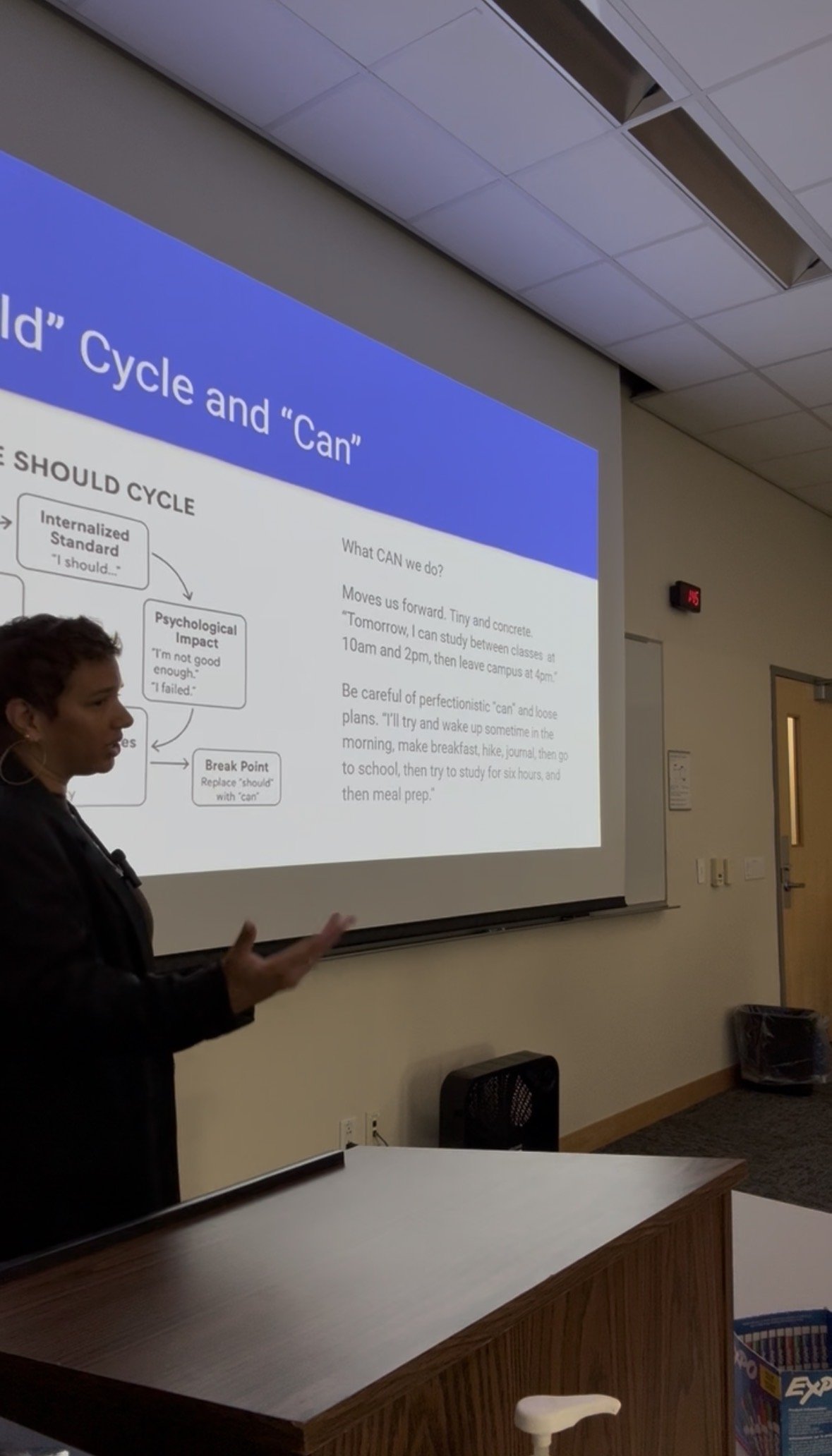
Should → Can is a framework I developed to help people move from abstract expectations toward concrete, manageable action—even when uncertainty is still present.
From Therapy to the Classroom
Should → Can grew out of my work as a therapist and has continued to develop through my work with students, educators, and organizations.
I use the framework in my private practice, have guest lectured with college students about should thinking, and have presented this work at the Lilly Conference on College and University Teaching. I am also preparing to facilitate a session at the 2026 Students in Transition Conference exploring how should can turn normal uncertainty into a sense of failure.
The framework has also moved beyond higher education. In my work with the City of Berkeley, I have used Should → Can with adults to explore self-care, expectations, and how we can take action without adding more pressure.
Across these different spaces, the question is similar: How do we move when we don't know the “right” thing to do next?
The Should → Can Framework
CATCH
Notice the should.
WHY
Get curious about the expectation underneath it.
CAN
Identify something concrete you can do next.
Can doesn't require certainty. It doesn't require us to convince ourselves that everything will work out.
It gives us somewhere to go next.
Should → Can in Education
Students navigating transitions often carry expectations about what they should already know: their major, their career, the right decision, how to participate, or where they're supposed to be by now.
When uncertainty becomes evidence that they're doing something wrong, students can become more focused on avoiding the wrong choice than exploring what's possible.
Should → Can gives educators another way to respond—not by providing certainty, but by helping students identify what they can do next.
The Should → Can Toolkit is a practical resource for educators, advisors, counselors, and others supporting students through uncertainty and transition.
Inside, you'll find tools for recognizing should thinking, understanding the Should Cycle, shifting from Should → Can, creating a concrete Can Plan, and practicing Catch → Why → Can.
Beyond the Classroom
Should → Can began with what I was hearing in conversations with college students, but “should” isn’t limited to students.
We carry expectations about where we should be in our careers, relationships, families, finances, health, and lives. And when we focus on where we think we should be, it can become harder to identify what we can actually do next.
The same shift applies: Can doesn’t require us to have everything figured out. It gives us somewhere to start.